Praduan Saha
Loading work
An autonomous bookkeeping agent for small businesses, where the real subject isn't bookkeeping; it's trust: how much authority an owner hands a system that moves their money. Built from a functional spec that marks every requirement Tested, Intent or Hypothesis, so its guesses are labelled as guesses. The working build enforces its own rules in the database rather than the interface: an append-only ledger, and two safety rails no setting can reach. You can open the books and use it on this page.
A design and functional prototype on mock data, not a production system.
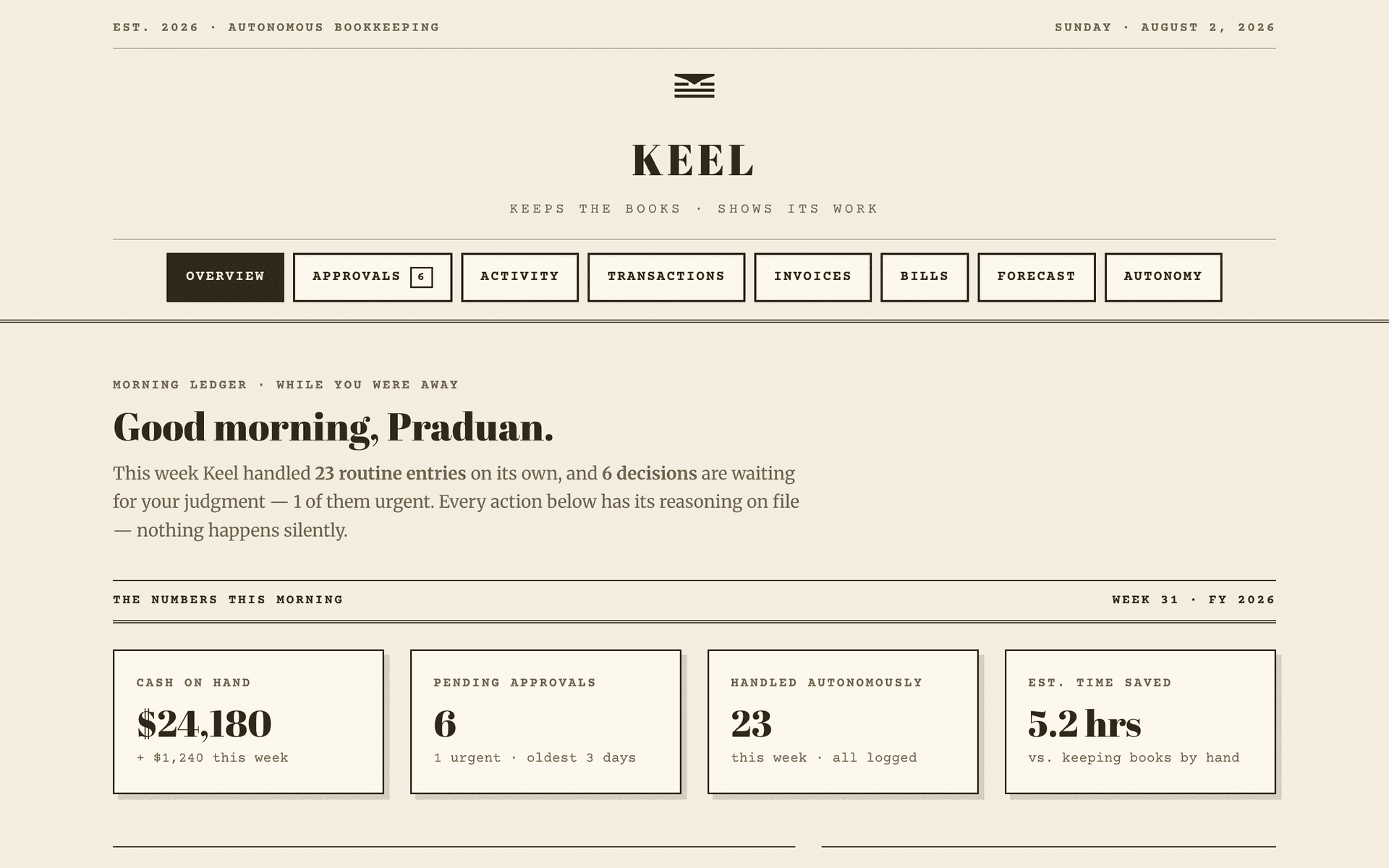
The real prototype, not a recording. It opens on the sign-in screen: any email and any password get you in, or take the two-minute tour instead. Runs entirely in your browser.The real prototype runs in your browser, but it needs a wider screen than this to be usable in-page.
Open the demo ↗The hard problem in an agent that handles your money isn't the bookkeeping. It's how much you'll let it do without asking, and that has to be earned by the product, not assumed on day one.
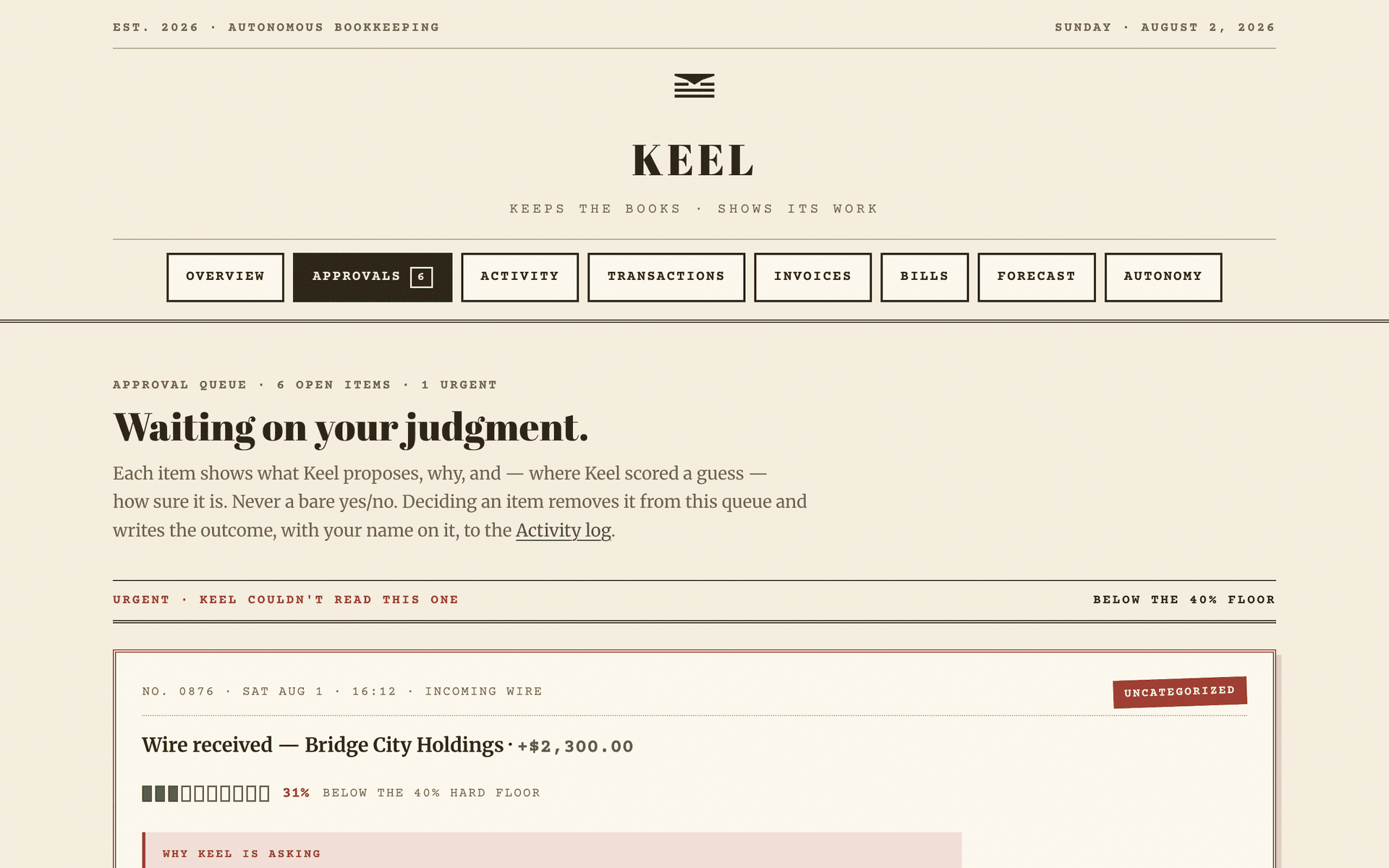
Launch it and you land on the morning ledger: cash on hand, what Keel handled overnight, what it stopped for. From there the whole product is walkable. Approvals opens with an urgent item: a $2,300 wire from Bridge City Holdings at 31% confidence, below the 40% floor where Keel stops guessing entirely. Every card states the proposed action, the reasoning in plain language, a confidence meter that ticks and prints the number, and the options. Never a bare yes/no.
Activity is the other half of the argument. Every entry expands to the full reasoning trace and the attribution, KEEL · AUTO or OWNER, including a correction that points back at the entry it supersedes rather than editing it. Nothing in the log has ever been changed after the fact, and further down this page there's a reason that's a claim I can make rather than a promise I'm asking you to take.
Three surfaces sit in the window chrome: the App, the Design system it's built from, and the Build plan that sequenced it.
Keel started from a functional specification for an autonomous bookkeeping agent: the genre of document that states requirements with equal confidence whether they've been proven or invented that morning. This one refuses to. Every requirement is marked Tested, Intent or Hypothesis, so the 90% categorization threshold and the flat $10,000 cash-flow floor are both filed openly as guesses that need real usage data before anyone defends them. And the spec is clear about what it's actually for:
The core design problem is not bookkeeping. It's trust.
QuickBooks does bookkeeping. The opening the spec identifies is being the first bookkeeper you can watch think, so every screen answers one of three questions. What did you do without me? What do you need from me? What are you allowed to do?
The design borrows from the financial artifacts people already trust without being asked to: the bank passbook, the ruled ledger, the typewritten statement, the rubber stamp. Cream paper, warm near-black ink, a muted banking teal. Abril Fatface for the crest, Merriweather for prose, and Courier Prime for every number, date and label: monospace gives aligned ledger columns for free. Square corners, hard letterpress shadows, double rules. No gradients, no blur, no dark mode.
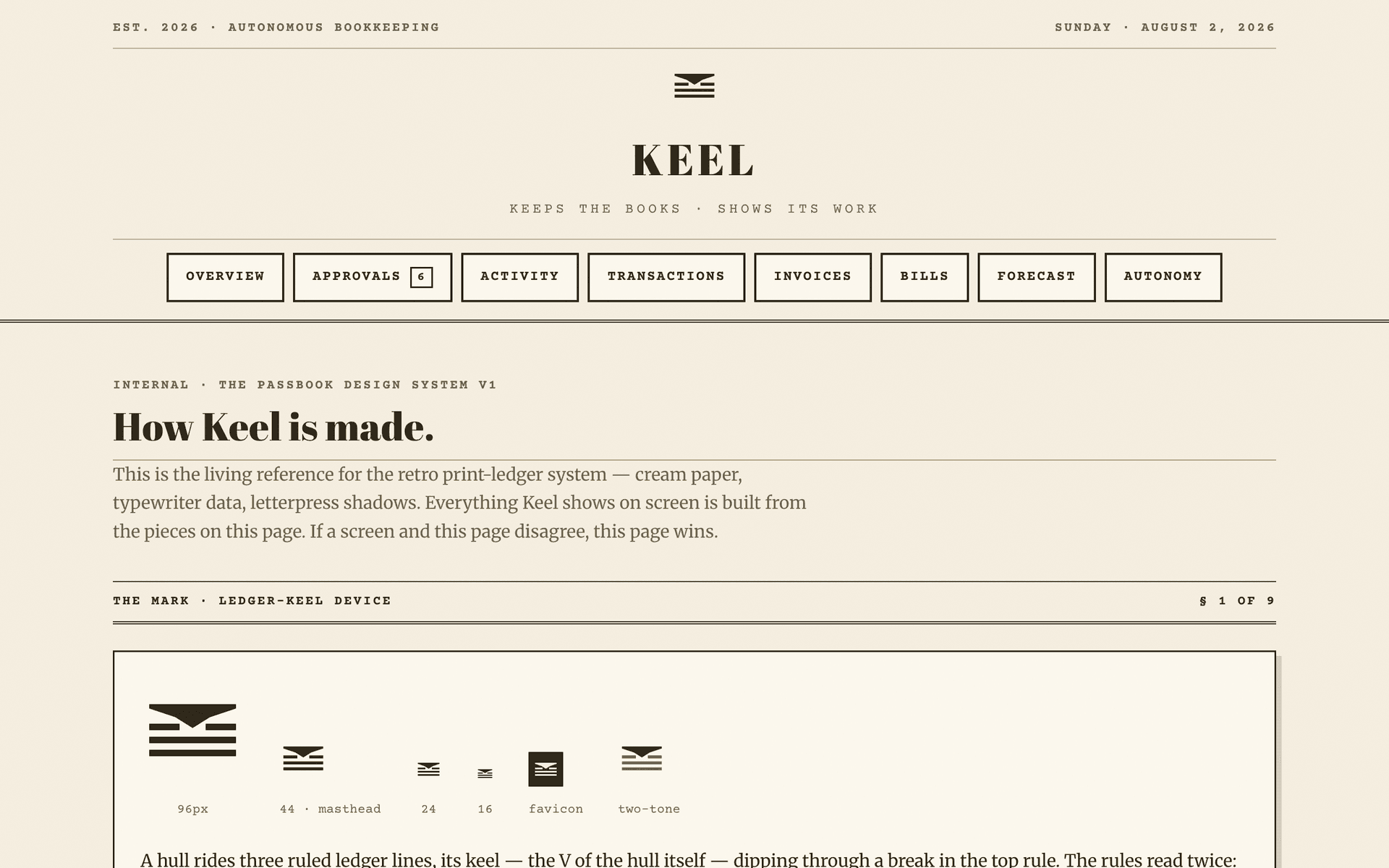
Paper is the right metaphor because the product's whole claim is you can check my work, and a bound ledger is the most legible image of a record that can't be quietly rewritten. The mark follows the same logic: a hull riding three ruled lines, its keel dipping through a break in the top rule. The rules read twice, waterline and ledger paper, and the two unbroken ones beneath are both "on an even keel" and the accountant's double rule under a closed total.
Alongside the static reference is a working build: Node 24, server-rendered from SQLite, no framework, no node_modules, and no client-side JavaScript in either build. Three of its ideas are the point of the whole thing.
Append-only is a database property, not a promise. The events table carries BEFORE UPDATE and BEFORE DELETE triggers that RAISE(ABORT). No code path, careless or deliberate, can rewrite history. A correction is a new row pointing at the one it supersedes, and a test re-reads the superseded row afterwards to prove it's untouched, word for word.
"No silent actions" is a NOT NULL constraint. Every event requires a non-empty, human-readable reason. An action without one can't be recorded, which means it can't happen.
The locked rails aren't settings. First payment to a new vendor, and anything touching a dispute or an anomaly, always stop for a human. Those live as constants in the rules engine, checked before configuration is read, and the test suite cranks every dial to its most permissive legal value to assert they hold.
Three stages left to right. A request for a $99,999 auto-pay ceiling, POSTed straight past the interface, arrives at the locked rails; the rails are constants in the rules engine, read before any configuration; what is recorded is $2,000. Bypassing the interface changes nothing, because the interface was never what was holding the limit.